What You’ll Learn About California Home Insurance Replacement Cost
Understanding what it would actually cost to rebuild your home after a disaster is more important than ever, especially here in California. This guide breaks down the often-confusing world of insurance replacement cost. We’ll explore the difference between market value and what it takes to put your home back together, why California presents unique challenges, and how to make sure you’re truly covered. You’ll learn about the factors that inflate rebuilding costs, the dangers of underinsurance, and practical steps you can take to protect your biggest asset.
Step 1: Replacement Cost Isn’t What You Think It Is
For most California homeowners, their home is their biggest investment. You’ve probably heard the term “replacement cost” thrown around with insurance. It sounds simple enough. But here’s the thing: it’s not the same as your home’s market value. Not even close. Many folks confuse the two, and that misunderstanding can leave you seriously underinsured if disaster strikes.

What Replacement Cost Actually Means
Think of it like this: replacement cost is the amount of money it would take to completely rebuild your home from the ground up, using similar materials and quality, at current construction prices. This includes everything from tearing down the damaged structure and hauling away debris, to pouring a new foundation, framing, roofing, plumbing, electrical, and all the finishes inside. It’s about restoring your home to its pre-loss condition, or as close as possible.
Why It’s Different from Market Value
Your home’s market value is what someone would pay for it right now. It’s influenced by land value, location (hello, beachfront property in Malibu!), school districts, local amenities, and the overall real estate market. The market value of a home in, say, Ventura County, might be $1 million, but the actual cost to rebuild that same house could be $600,000. Or, in a post-disaster scenario, it could be $1.5 million. Land value doesn’t burn down. Your insurance company isn’t going to pay you for the dirt your house sits on. They’re only interested in the structure itself and your personal belongings.
Conversely, in some areas, especially older neighborhoods or places with unique architecture, the cost to rebuild could easily exceed what the house would sell for on the open market. This is particularly true if you’re rebuilding to modern codes, which we’ll get to.
Step 2: The California Context — Why Rebuilding Here Is Unique
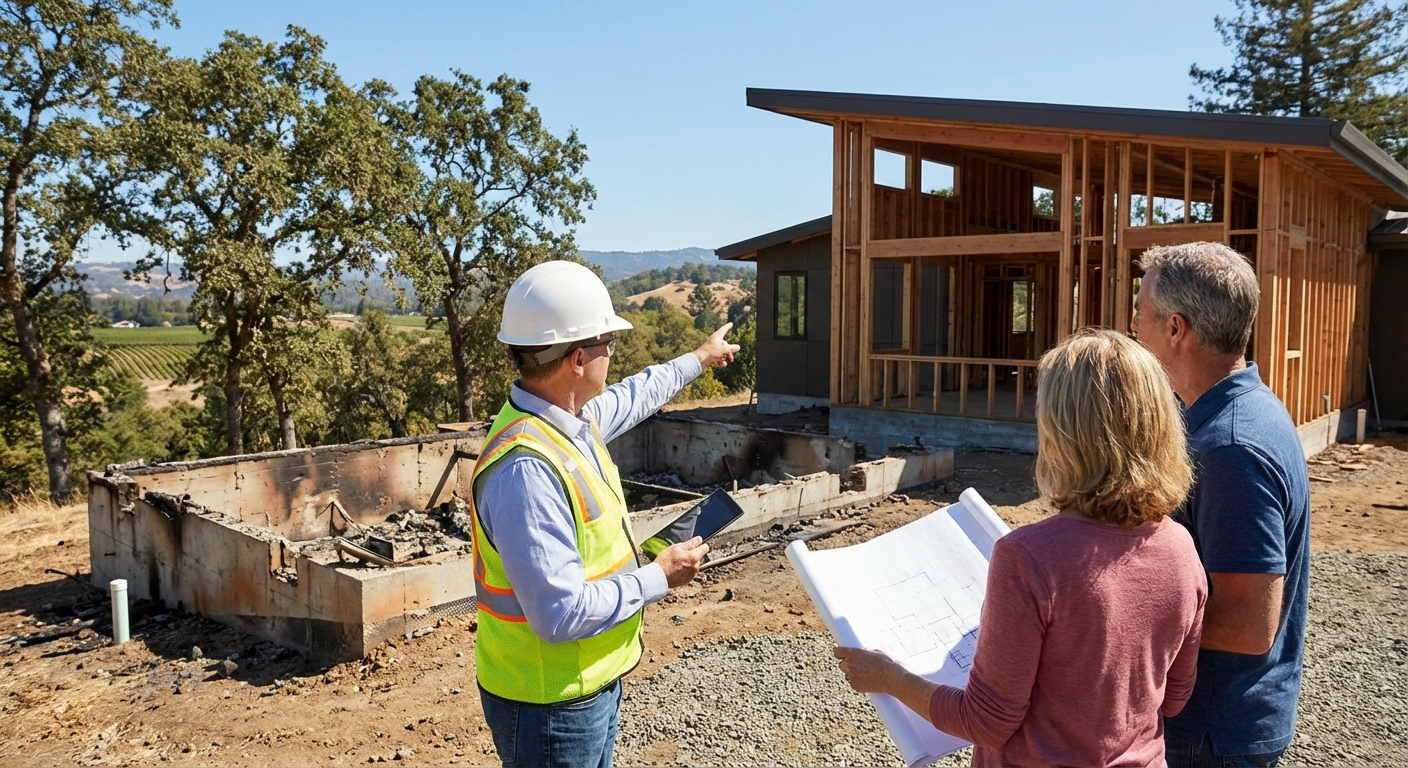
If you live in California, you already know things are different here. Our state faces specific challenges that make calculating and covering replacement cost a particularly thorny issue. Wildfires, earthquakes, mudslides—these aren’t just headlines; they’re real threats that push construction costs sky-high when rebuilding efforts begin.
The Wildfire Effect
Consider the recent history of wildfires across the state, from the Sierra foothills to the canyons of Southern California. When a large area burns, like parts of Santa Rosa or Paradise, demand for contractors, skilled labor, and building materials skyrockets. Suddenly, there aren’t enough roofers, electricians, or drywall installers to go around. What happens? Prices jump. That’s simple supply and demand. A rebuild that might cost $300 a square foot in a normal market could easily hit $500 or $600 a square foot in a post-fire boom. This isn’t theoretical. It’s happened again and again.
Building Codes and Regulations
California has some of the strictest building codes in the nation. For good reason, of course. We’re trying to build safer, more energy-efficient, and more resilient homes. But here’s where it gets interesting: if your home is damaged beyond a certain percentage, you might be required to rebuild it to *current* building codes, even if your original home was built decades ago. This could mean installing sprinklers, using fire-resistant materials, upgrading electrical systems, or making seismic retrofits. These aren’t cheap upgrades, and they add significantly to your total rebuild cost.
Labor and Material Costs
Even without a disaster, construction costs in California are generally higher than in many other states. Skilled labor commands higher wages. Permits can be expensive and take time. The cost of materials, from lumber to concrete, also reflects our unique market. When you combine these baseline costs with the sudden demand after a widespread event, you’ve got a recipe for serious sticker shock.
Step 3: Factors That Drive Your Replacement Cost Estimate Up
It’s not just the square footage that determines your rebuild cost. Many factors play a part, and ignoring any of them can leave you with a massive gap between what you get from your insurer and what you actually need.
Materials and Finishes
Are your kitchen countertops granite or laminate? Do you have custom cabinetry or builder-grade? Hardwood floors or carpet? These choices make a huge difference. Rebuilding a home with high-end finishes will cost far more than rebuilding a basic tract home.
Labor Costs
As mentioned, skilled labor is expensive, especially in California. Plumbers, electricians, framers, roofers—they all command professional rates. And if you’re in a specific area like the Santa Clarita Valley or parts of the Inland Empire, those costs can vary.
Permits, Fees, and Inspections
Before you can even break ground, you’ll need permits from your city or county. These aren’t free, and they can be time-consuming to acquire. Each stage of construction will also require inspections, adding to the timeline and sometimes the cost if issues are found.
Demolition and Debris Removal
Before rebuilding, you have to clear the site. Demolishing a damaged structure and hauling away tons of debris—especially after a fire—is a significant expense. This can run into tens of thousands of dollars, depending on the size of your home and the extent of the damage.
Inflation and Supply Chain Issues
Here’s a big one. Construction costs don’t stay still. We’ve seen significant inflation in materials and labor over the last few years. Premiums jumped 40% between 2022 and 2024 for many homeowners. A rebuild estimate from five years ago might be completely inadequate today. Global supply chain hiccups can also delay projects and drive up prices for specific materials. You might wait months for a particular type of window or appliance, and pay more for it when it finally arrives.
Step 4: How Insurers Calculate It (and Why It’s Tricky)
Insurance companies don’t just pull a number out of thin air. They use specialized software tools, like Xactware or CoreLogic, which have databases of local construction costs, material prices, and labor rates. They’ll input details about your home: square footage, number of bathrooms, type of roof, quality of finishes (basic, mid-grade, high-end), and even specific features like a custom deck or a fancy fireplace.
The Art vs. Science Dilemma
These tools are good, but they’re not perfect. They rely on averages and assumptions. Your unique home, with its specific quirks or custom touches, might not fit neatly into their categories. An exterior inspection might happen, but often, the initial estimate is based on limited information. That’s not the whole story. Sometimes, an insurer’s estimate can fall short of what a local contractor would actually charge to rebuild.
Even major players like State Farm, AAA, or Farmers use these systems, but the inputs and interpretations can vary. This is where an experienced eye comes in handy—someone who understands both the insurance side and the realities of California construction.
Step 5: The Danger of Underinsurance
This is where things get serious. If your policy’s dwelling coverage limit—the maximum amount your insurer will pay to rebuild your home—is less than the actual replacement cost, you’re underinsured. A lot of people are. And it can be financially devastating.
The Financial Fallout
Imagine your home burns down in a wildfire. Your policy says you have $500,000 in dwelling coverage. But the actual cost to rebuild, factoring in current labor rates, materials, and new building codes, is $750,000. That’s a $250,000 gap you’d have to cover out of your own pocket. Most families can’t absorb that kind of hit. It can lead to foreclosure, bankruptcy, or force you to rebuild a much smaller, less desirable home than the one you lost.
The “80% Rule” (Simplified)
Many policies include a “co-insurance” clause, often called the 80% rule. If you’re insured for less than 80% of your home’s replacement value, the insurer might only pay a percentage of your partial losses. For example, if you have a $50,000 roof claim, but you’re only insured for 70% of your home’s total replacement cost, they might only pay 70% of that $50,000, minus your deductible. It’s a penalty for not carrying enough coverage. Big difference.
Step 6: Protecting Yourself — Getting the Right Coverage
So, what can you do? You need to make sure your policy has enough dwelling coverage to truly rebuild your home. But wait—there are also specific endorsements that can provide extra layers of protection.
Extended Replacement Cost (ERC)
This is a must-have in California. ERC provides an additional percentage of coverage above your dwelling limit, usually 20% to 50%. So, if your home is insured for $500,000 and you have 25% ERC, you’d actually have up to $625,000 available for rebuilding. This buffer is absolutely vital for covering those unexpected cost spikes after a widespread disaster.
Guaranteed Replacement Cost (GRC)
Less common now, but incredibly valuable if you can find it. GRC means the insurer will pay whatever it costs to rebuild your home, even if it exceeds your dwelling limit, as long as you initially insured it for 100% of their estimated replacement cost. It’s the ultimate peace of mind. However, many insurers have pulled back on offering GRC in California due to the high risks.
Ordinance or Law Coverage
Remember those strict California building codes? This coverage pays the extra cost to rebuild your home to current codes, even if your old home didn’t meet them. Without it, you could be on the hook for substantial upgrade costs. This is often a separate line item on your policy and can be a lifesaver.
Personal Property Replacement Cost
Don’t forget the stuff inside your home! Most policies offer “Actual Cash Value” for personal property by default, meaning they’ll pay you the depreciated value of your belongings. But you want “Replacement Cost” coverage for your personal property. This means if your five-year-old couch burns up, they’ll pay you what it costs to buy a new, similar couch, not just what your old one was worth.
Step 7: Working with a Pro — Your Best Bet
Trying to figure all this out on your own can feel like navigating a maze blindfolded. This is where an independent insurance agent becomes an invaluable partner. They don’t work for one specific insurance company; they work for *you*. They can compare policies from multiple insurers—State Farm, AAA, Farmers, and many others—to find the best fit for your specific needs and budget.
An experienced agent understands the nuances of the California market. They know which carriers are still writing policies in high-risk areas, what endorsements are truly necessary, and how to accurately assess your home’s replacement cost. They can help you avoid the pitfalls of underinsurance and ensure you’re getting the most bang for your buck.
Karl Susman, from California Insurance Quote Pros (CA License #OB75129), has seen firsthand the devastation of underinsurance. He and his team specialize in helping California homeowners get the right coverage. They can walk you through the process, explain your options in plain language, and help you get a solid quote. Don’t leave your biggest asset to chance. Get a personalized quote today and protect your home properly.
Step 8: Regular Reviews and Updates
Your home’s replacement cost isn’t static. It changes. Inflation, local construction trends, major renovations you undertake—all these things impact what it would cost to rebuild. Which brings up something most people miss. You shouldn’t just “set it and forget it” with your home insurance.
Annual Check-ups
Make it a habit to review your policy with your agent every single year. Discuss any home improvements you’ve made. Did you add a new bathroom? Build a detached ADU in the backyard? Those additions significantly increase your replacement cost. Your agent can also advise you on current construction costs and recommend adjustments to your dwelling coverage to keep pace with inflation.
Market Fluctuations
Even if you haven’t changed a thing about your house, the cost to rebuild it can go up. Lumber prices can surge. Labor shortages can drive up hourly rates. Staying on top of these trends is part of your agent’s job, and it’s why those annual conversations are so important.
FAQ About California Insurance Replacement Cost
Q: My home’s market value is $800,000, but my insurer says the replacement cost is $600,000. Is that right?
A: Yes, it’s often correct. Market value includes the land, location, and demand, which don’t factor into rebuilding the physical structure. Your insurer is focused on the actual construction costs, not what someone would pay for the property as a whole.
Q: What if I can’t find an insurer to cover my home because I’m in a high-fire risk area?
A: If traditional insurers won’t cover you, you might need to look at the California FAIR Plan. It’s a state-mandated program that acts as an “insurer of last resort” for properties in high-risk zones. It provides basic fire coverage, and you’ll often need a “wrap-around” policy from another insurer to cover other perils like liability or theft.
Q: Does my deductible apply to replacement cost claims?
A: Yes, your deductible will always apply to a covered loss. If you have a $2,500 deductible and your rebuild costs $500,000, your insurer will pay $497,500.
Q: How often should I update my home’s replacement cost estimate?
A: Ideally, you should review your replacement cost coverage annually with your insurance agent. This allows for adjustments based on inflation, any home improvements you’ve made, and changes in local construction costs.
Making sure your California home is adequately insured for its true replacement cost is one of the smartest financial moves you can make. It protects your family’s future and provides peace of mind in a state where disasters are, unfortunately, a real possibility. Don’t wait until it’s too late to find out you’re underinsured. Talk to a professional who understands the unique challenges of our state’s insurance market. Reach out to Karl Susman and the California Insurance Quote Pros (CA License #OB75129) today to review your coverage.
This article is for informational purposes only and does not constitute financial advice.